introduction

Introduction to the blog

Introduction

Over the years I would occasionally write short essays, which helped me process what was going through my mind. Frequently these were not very coherent, being sketches of random thoughts. Some captured observations I made while travelling, often noting differences or similarities between one place and another. Others were philosophical. Some were reactions to political events or current affairs.

Ordinary moments often stirred these thoughts: walking from Gate 3 to Gate 24 at a modern airport terminal, sitting on a bus, watching a house sparrow land on a roof, observing a barefoot hawker sell packets of peanuts, reading the news, or enjoying the proximity of an elephant feeding just in front of my tent. All of these stimulate reflection in different ways and for varied reasons.

A thought may surface because of something said or seen beforehand. Whatever the trigger, it connects to a myriad of other memories and ideas — consolidating existing beliefs, or provoking new questions. The locations, timing, surrounding events, and my emotions are dynamic, shifting back and forth.

Questions

The questions that keep resurfacing are many and varied: Why are things the way they are? Why is oil so important in today’s world? What drives global conflicts? Why does extreme wealth exist alongside desperate poverty? Why is religion so important? Why do diseases like bird flu appear out of the blue (a question I was already asking in 2009, before Covid-19)? Why do we need passports and visas to travel? Why is Africa poor and North America rich? How did humans become Earth’s most dominant land species?

These lead to deeper reflections: Are these conditions inevitable, and can we influence them? Are we helpless, or is our fate predestined? Can we ever know the answers? If not, is there a rational way to draw closer to them?

This captures the thought process — a question leads to possible answers, raising more questions. And so the cycle continues.

My motivation for writing

The greatest driving force behind gathering these thoughts into writing is a sense of confusion and despair about living in a highly complex modern world.

I read about the rise in mental health issues and sense that many of us don’t know where we are heading, or why. The devastating realities are hard to ignore: billions living in abject poverty with little hope, an environment rapidly deteriorating, resources consumed at an unsustainable rate, and biodiversity in decline.

And yet others are optimistic. We live in an age of unprecedented access to knowledge, with astounding scientific discoveries, improved health services, remarkable efficiency of food production, and the ease of trade and travel.

If we have managed these successes, surely we can address the problems that remain? Is this not so?

Over time, events in our world developed — generally for the worse — and I began to feel a sense of urgency to compile these writings into something more coherent. I felt that events had caught up with me: scenarios I had once pondered as distant possibilities were now happening, or in the process of doing so. Waiting ceased to be an option.

These thoughts are complex, varied, and at times confuse me. Writing them down is partly an attempt to make sense of them. I hope that you benefit from reading about some of them, and that you are are stimulated by Dye-A-Logue.

The structure of this blog

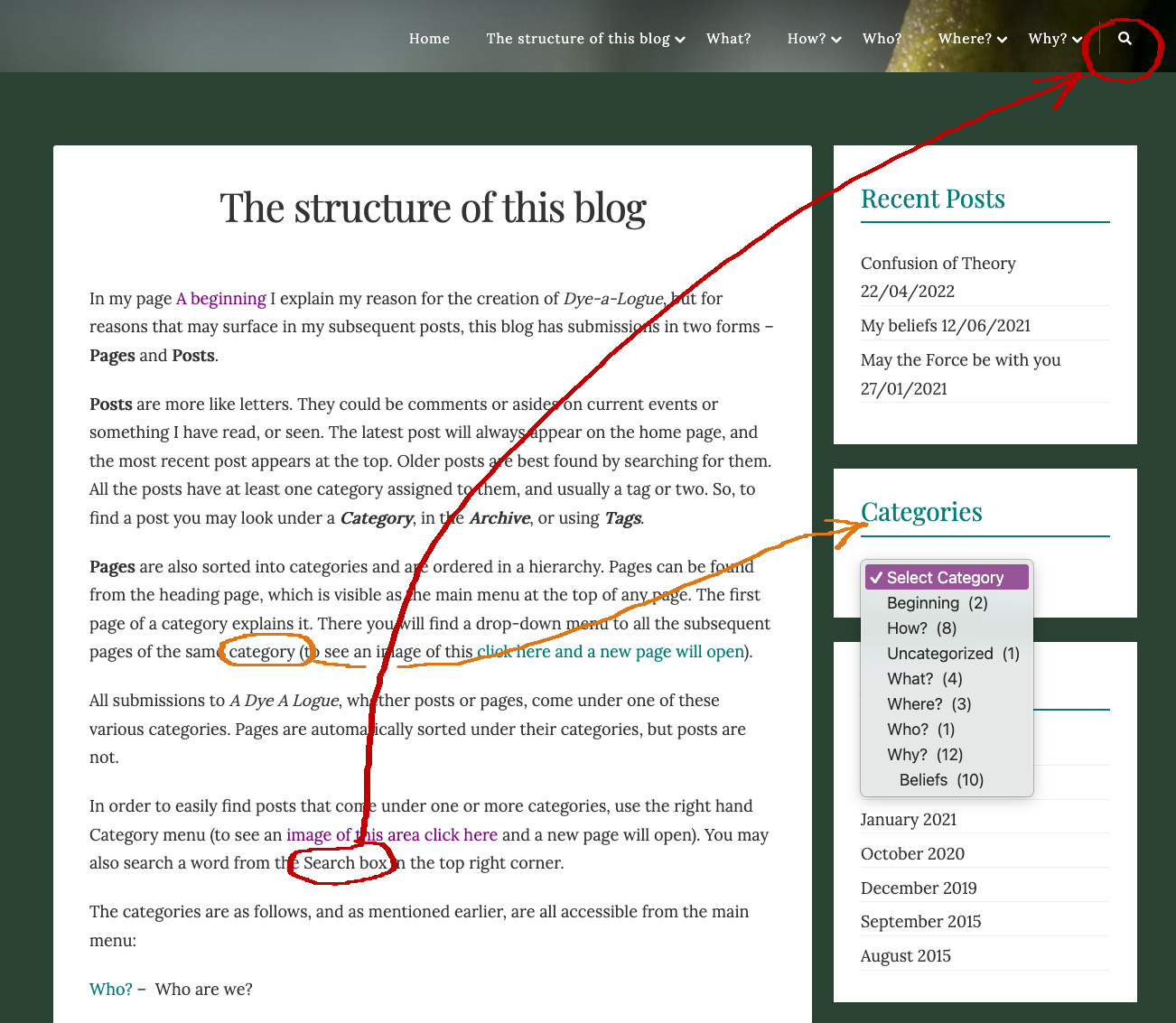
If you’ve just arrived here, this page is meant to help you find your way around — and to explain how the material is structured, in case you’d like to read with more intention than just scrolling through the latest post.

In my page A beginning I explain my reason for the creation of Dye-a-Logue, but for reasons that may surface in my subsequent posts, this blog is organised into – Themes, Series, Chapters, Posts and Asides.


The Main Themes


The core of this project is organised into five themes which are almost synonymous with the Series, but not entirely:

  • Problems —the greatest challenges we face,
  • Who Are We?
  • How the World Works
  • Where Are We Headed?
  • Solutions


These themes are in the main menu across the top of the site. Each one leads to a page that lists its posts in the order they’re meant to be read — not necessarily the order they were published, but the order that will make the most sense if you’re following the argument from the start, as if you were reading a book.


Series


Series are the highest structural unit and unsurprisingly they are almost identical to the main themes, except there are two series, not one, to the Problems theme. The first is the first part in this blog, titled What are the Main Problems? The other is titled A revision of the main problems and is the fourth series in the blog. As a result the series are as follows –

  • Problems
  • Who Are We
  • How the World Works
  • Problems revised
  • Where Are We Headed?
  • Solutions
  • Asides

Where are we headed? is the forth theme, but is not the forth, but the fifth series.

Chapters and Posts

Within each part, the material is divided into chapters. Some chapters are short enough to be contained in a single post. Others cover more ground than a single post comfortably holds, so I’ve split them into several posts — each one focused on a specific point, with its own title, and each linked to the one before and after it, so you can move through the chapter in sequence if you’d like.

You don’t need to read every post in a chapter to get something out of it; each one is written to stand on its own. But if you’re working through a part from the beginning, the posts are ordered to build on each other, often following a train of thought.


Asides

From time to time, I step outside the main sequence to write something adjacent to it: perhaps a comment on how something that is happening currently is linked to the material, or a tangent that doesn’t fit neatly into the main thread but seems relevant anyway. These are kept separate from the core chapters so the main argument stays easy to follow, but each one links back to the post it relates to, in case you want the more complete context.


Glossary

Some of the language I use carries a specific meaning in this project, so I’ve written longer explanations of key terms and concepts as their own posts. You can find the full list on the Glossary page, with a short description of each term and a link to the complete entry. If you come across an unfamiliar term while reading, it’s worth checking there. You can also check the tag definitions.


A Note on How to Read This

You’re welcome to read however suits you — start with whichever theme interests you most, follow a single chapter through to its end, or wander through the asides and glossary on their own. The structure exists to make that kind of nonlinear reading possible, not to insist on a single correct path through the material. Alternatively, you can read this like a book, starting with the introduction and moving on to the first series – Problems – the greatest challenges that we face.