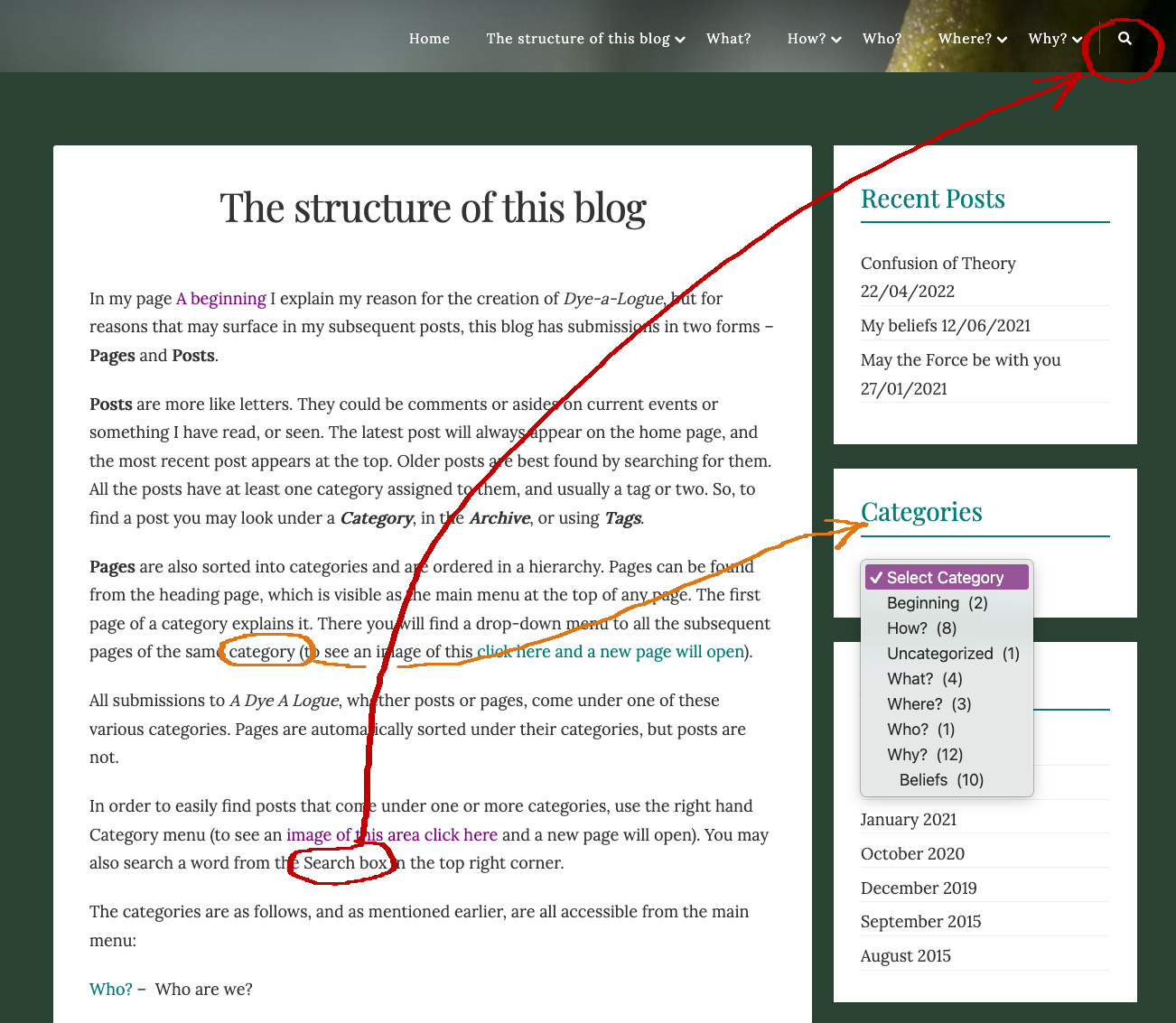
If you’ve just arrived here, this page is meant to help you find your way around — and to explain how the material is structured, in case you’d like to read with more intention than just scrolling through the latest post. The blog is organised into a hierarchical order starting with Series, then Chapter and finally Post.
Series
All submissions to Dye A Logue, except the Asides, are organised into five Series – the highest structural unit. The Series (= Categories) are as follows –
• 1. Problems — what appears to be the greatest challenges we face
• 2. Who Are We? – A look into human nature
• 3. How the World Works – What are the rules we impose and the overall real of our surroundings?
• 4. Problems revised – a revision of problems we face after considering factors explored in other themes.
• 5. Where Are We Headed? – What is the outlook for the future and how sure can we be?
• 6. Solutions – Is our future inevitable and if not what can we do to solve problems?
• Asides – Posts that do not fall into any of the themes directly but have been included because in some way these asides or tangents are relevant. They include posts on beliefs, and others on definitions which form the glossary, for example.
You’ll find these listed across the top of the site. Each one leads to a page that lists its posts in the order they’re meant to be read — not necessarily the order they were published, but the order that will make the most sense if you’re following the argument from the start.
Chapters and Posts
Within each series, the material is divided into chapters. Some chapters are short enough to be contained in a single post. Others cover more ground than a single post comfortably holds, so I’ve split them into several posts — each one focused on a specific point, with its own title, and each linked to the one before and after it, so you can move through the chapter in sequence if you’d like.
You don’t need to read every post in a chapter to get something out of it; each one is written to stand on its own. But if you’re working through a part from the beginning, the posts are ordered to build on each other, often following a train of thought.
The latest post will always appear on the home page and the most recent post appears at the top. However this may only be useful to you if you have already read all the other posts.
Otherwise there are several ways to find a post – you can read in the order intended by following through the list of chapters and posts under each Series in the menu at the top of the page. Alternatively you may use the right hand Category (= Series) search (to see an image of this area click here and a new page will open), or search in the Archive or by Tags.
Asides
From time to time, I step outside the main sequence to write a post on something adjacent to it: perhaps a comment on how something that is happening currently is linked to the material, or a tangent that doesn’t fit neatly into the main thread but seems relevant anyway. These are kept separate from the core chapters so the main argument stays easy to follow, but they often link back to the post they relate to, in case you want the more complete context. They can be found using the same methods as outlined under Chapters and Posts (above), or from the menu at the top of the page in the Asides list.
Glossary
Some of the language I use carries a specific meaning in this project, so I’ve written longer explanations of key terms and concepts as their own posts. You can find the full list on the Glossary page, with a short description of each term and a link to the complete entry. If you come across an unfamiliar term while reading, it’s worth checking there. You can also check the tag definitions.
A Note on How to Read This
You’re welcome to read however suits you — You may read it in the order intended, like a book, starting with the first series and ending with the last. In this case start with Series 1 – an examination of the current world´s problems (seen through a human lens).
Alternatively you could explore whichever series interests you most, follow a single chapter through to its end, or wander through the asides and glossary on their own. The structure exists to make that kind of nonlinear reading possible, not to insist on a single correct path through the material.